

Aerospace & MRO
Safe movement of heavy components and controlled cleanliness in aerospace production and MRO environments.
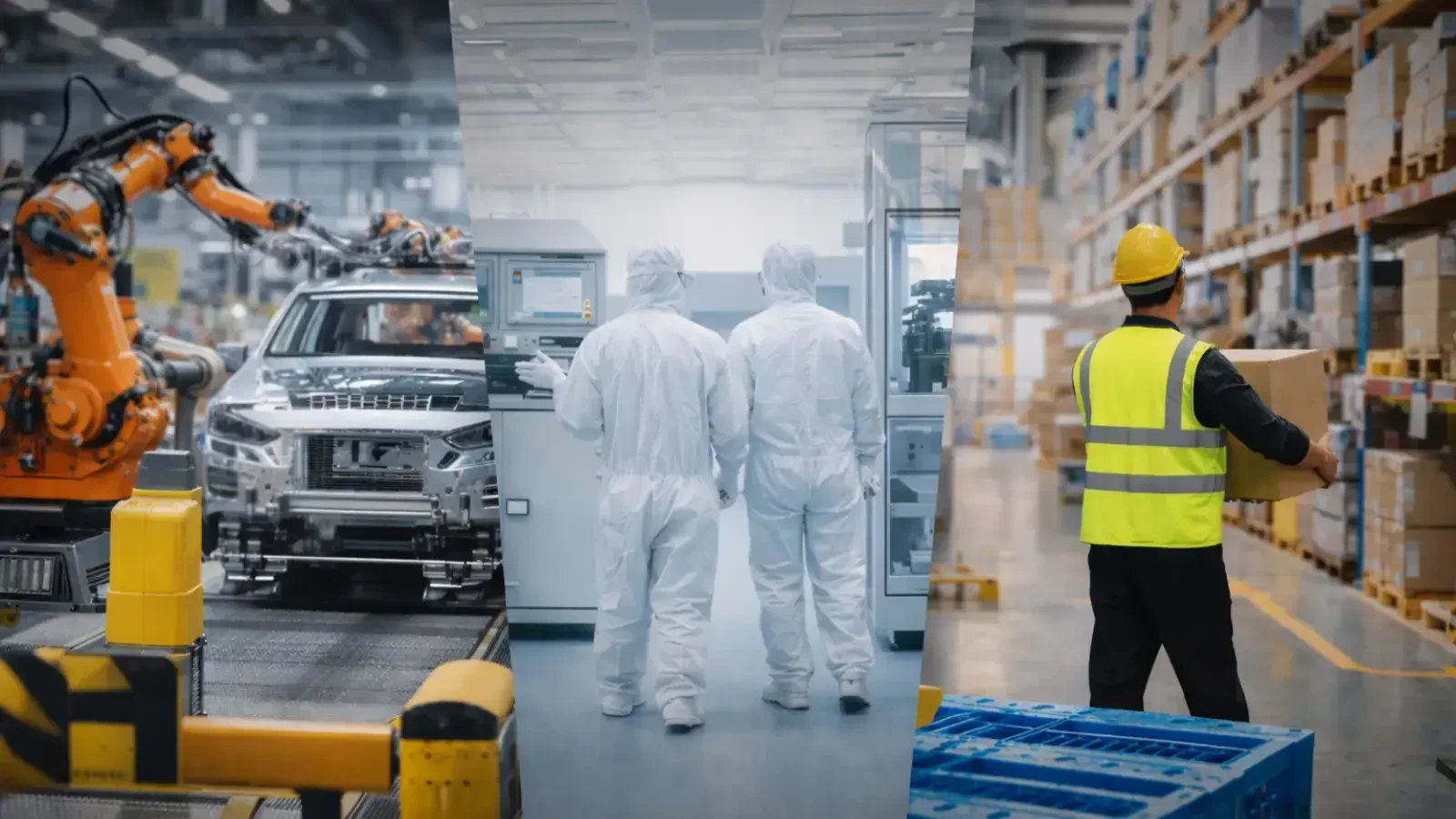
Each sector comes with its own requirements and challenges. Select your industry to discover relevant applications and solutions.
Industrial environments come with different operational challenges. Some require strict hygiene standards, while others involve handling heavy loads or managing complex logistics flows.
SEVENSEAS helps maintain cleanliness in critical areas, protects infrastructure exposed to impact and improves control over the movement of equipment and materials across production and logistics spaces.

Contamination from dust, particles or debris brought in by footwear and wheels can affect sensitive production processes.
Controlling contamination at entry points helps maintain consistent operational conditions.

In industrial spaces, daily traffic of forklifts, pallet trucks and service vehicles creates constant impact risks.
Protection systems help prevent damage to buildings, equipment and critical areas.

Moving heavy loads or machinery inside production areas requires control and precision.
Material handling solutions enable safe and efficient movement without relying on manual effort.


In most factories, risks are not evenly distributed — they tend to concentrate in key points of the operational flow.
These are typically the areas where:
This is where issues most often occur: accidents, contamination, or inefficiencies.
At Sevenseas, we always start with a clear, on-site understanding of these areas. We don’t offer standard solutions — we identify where risks occur and why.
Based on this, we act in three essential directions:
Safety
We protect people, equipment, and infrastructure in high-risk areas, reducing the impact of accidents and collisions.
Hygiene & contamination control
We limit the transfer of dirt and particles between zones, helping maintain cleanliness and quality standards.
Operational efficiency
We optimize internal flows and material handling, making processes smoother and more predictable.
The result is not just a safer or cleaner factory, but one that performs better — every day, in real production conditions.
In many factories, inefficiencies are not always obvious — but they occur every day in processes that seem “normal”.
Most often, they are linked to:
But there are also less visible losses with significant impact:
These are not just operational issues — they translate directly into costs:
In practice, optimization comes from controlling these critical points — not just speeding up processes.
Operational efficiency
Reducing handling time and eliminating bottlenecks.
Safety
Limiting risks that can lead to costly disruptions.
Hygiene & contamination control
Reducing the risk of non-compliance and quality loss.
The result is a more stable and predictable operation, where hidden costs are reduced and processes run consistently without disruption.
Safety in high-traffic areas is not just about rules or markings — it starts with a clear understanding of real operational risks.
At Sevenseas, our approach begins with a structured risk analysis.
We assess the factory layout and the type of traffic involved:
Based on this, we calculate the maximum impact force — for example frontal impact (90°) or angled impact (e.g. 45° in corridors). This results in a clear impact energy value for each area.
This analysis allows us to define the right solutions:
Properly engineered protection barriers
We recommend barriers designed to withstand the actual impact forces in each zone. In practice, different areas require different types of barriers.
Separation of pedestrian and vehicle flows
We identify interaction points and implement segregation solutions to minimize risk.
In an ideal setup, pedestrian and vehicle flows would never intersect.
In reality, such intersections exist in almost every factory.
That’s why we provide adapted solutions:
Signalized crossings and visual warning systems
We implement traffic lights and LED projection systems that clearly indicate when crossing is allowed or restricted.
Pedestrians can safely activate crossings using a push-button system, ensuring clear communication and visibility for operators.
In some cases, we also recommend redesigning internal flows — such as repositioning pedestrian routes — to reduce risks at the source.
The result is a coherent safety system based on real data, protecting people and infrastructure without disrupting operational flow.
In most factories, contamination does not come from a single source — it is the result of the continuous movement of people, equipment, and materials between different areas.
Every transition between zones introduces a risk: dust, particles, residues, or other contaminants that can affect product quality.
Effective contamination control is not just about periodic cleaning — it is about managing these transfers continuously, day after day.
At Sevenseas, we focus on the points where contamination is introduced or transferred:
At the entry to sensitive areas
We implement systems that reduce the amount of dirt brought in by wheels or footwear from the very first contact point.
Between zones with different cleanliness levels
We limit particle transfer using solutions adapted to each type of flow — pedestrian or logistic.
In high-traffic areas
We reduce accumulation and spread of contaminants with solutions that work continuously, without relying on frequent manual cleaning.
The goal is not just visible cleanliness, but control at an invisible level — where the biggest risks to quality actually occur.
The result is a more stable production environment, where hygiene standards are maintained consistently, not only after cleaning interventions.
In many factories, one of the most common challenges is moving heavy loads that are difficult to handle — equipment, industrial carts, large components, or high-value products.
These situations often lead to:
Traditional solutions are not always ideal.
Forklifts are large, difficult to manoeuvre in tight spaces, and require licensed operators, while manual handling exposes staff to injury and continuous physical strain.
In these cases, modern electric tug solutions (industrial pedestrian tugs) enable safe and controlled movement of heavy wheeled loads.
A single operator can:
These solutions are commonly used for:
Moving heavy or sensitive equipment
Ideal for non-palletized or high-value loads where control is critical.
Replacing forklifts in confined spaces
Compact design ensures superior manoeuvrability where traditional equipment is inefficient.
Reducing manual handling injuries
Eliminates physical strain and lowers the risk of musculoskeletal disorders.
Improving operational flexibility
Easy to integrate into existing workflows without major infrastructure changes.
The result is a safer, more flexible, and more efficient material flow — with less downtime, less effort, and greater control.
The automotive industry operates in a highly demanding environment where quality, technical cleanliness and delivery reliability are critical.
Components must comply with strict standards such as VDA 19.2 and ISO 16232, and particle contamination can lead to non-conformities, penalties or even loss of contracts.
In processes such as painting or sensitive assembly, even fine particles can cause defects or costly returns.
At the same time, automotive production involves:
Any disruption can impact the entire supply chain.
SEVENSEAS addresses these requirements by:
The result: operational stability, reduced risk of non-compliance and stronger OEM relationships.
The food and beverage industry operates within a strictly regulated environment where hygiene, food safety and traceability are essential.
Contamination can have serious consequences — from product recalls to loss of certifications and brand reputation damage.
Companies must comply with standards such as HACCP, IFS, BRC and ISO 22000, and remain audit-ready at all times.
At the same time, operations involve:
Maintaining a controlled and safe environment is critical for compliance and performance.
SEVENSEAS addresses these requirements by:
The result: compliance, audit readiness and protection of product quality and brand reputation.
The aerospace and MRO (Maintenance, Repair & Overhaul) industry operates in environments where precision, safety and control are critical, and tolerance for error is minimal.
Handled components are often high-value and highly sensitive to contamination, impact or improper handling.
Even minor particles or small impacts can affect performance, lead to costly repairs or cause operational delays.
At the same time, these operations involve:
Protecting infrastructure and equipment is essential to avoid disruptions and unnecessary costs.
SEVENSEAS addresses these requirements by:
The result: safer operations, protection of high-value components and reduced risk of disruption or unexpected costs.
Logistics facilities and warehouses operate in high-speed environments where material flow must remain continuous and efficient.
Constant traffic of forklifts and pallet trucks, combined with delivery pressure, creates increased risks of impact, infrastructure damage and safety incidents.
At the same time, these environments must continuously optimize:
In certain applications, cleanliness also becomes important, especially in logistics centers serving food, pharmaceutical or retail sectors.
Frequent impacts can damage racking, columns, loading areas and critical infrastructure, leading to maintenance interventions and disruption of operations.
Personnel safety is also critical in environments with high traffic and limited visibility.
SEVENSEAS addresses these requirements by:
The result: safer operations, reduced operational costs and increased logistics efficiency.
Daily traffic of forklifts and pallet trucks creates constant risks for people, infrastructure and production areas.
SEVENSEAS solutions use semi-flexible protection systems based on the principle of controlled flexibility, designed to absorb impact energy while enabling engineered deformation, reducing the forces transferred to the protected structure.
A key element is the FIXA-BLOCK anchoring system, patented by STOMMPY, which provides significantly higher pull-out resistance compared to conventional anchoring systems.
This reduces the risk of failure at the most critical point — the base connection.
Unlike highly flexible barriers, which require more clearance to operate and may allow contact with protected assets, SEVENSEAS systems are designed for controlled deformation and operate within a more compact footprint.
The result: improved protection for personnel and infrastructure, lower maintenance costs and long-term reliability.